
AI Agents Explained: Architecture, Components, and Real-World Applications
Explore AI agents, their building blocks, architectures, and real-world applications shaping the future of automation

Introduction
Artificial Intelligence (AI) has changed the way we work, learn, and communicate. A few years ago, AI was mainly used to answer questions, generate text, or create images. Today, it can do much more. AI can search the internet, read documents, write code, analyze data, schedule meetings, and even interact with different business applications.
The next step in this journey is AI Agents. Unlike traditional AI systems that simply respond to a prompt, AI agents can understand a goal, make decisions, use different tools, and perform tasks on their own. They can also remember information, adapt to new situations, and work through multiple steps before providing a result.
Because of these capabilities, AI agents are quickly becoming valuable across many industries. They are helping doctors manage patient information, assisting customer support teams, improving software development, automating business processes, and making everyday work faster and more efficient.
As AI continues to evolve, understanding how AI agents work is becoming an important skill for developers, architects, business professionals, and anyone interested in the future of technology.
What is an AI Agent?
An AI Agent is an intelligent software system that can understand a user's goal, decide what actions are required, use available tools, and continue working until the task is completed. Think of it like a smart digital assistant.
Building Blocks of an AI Agent
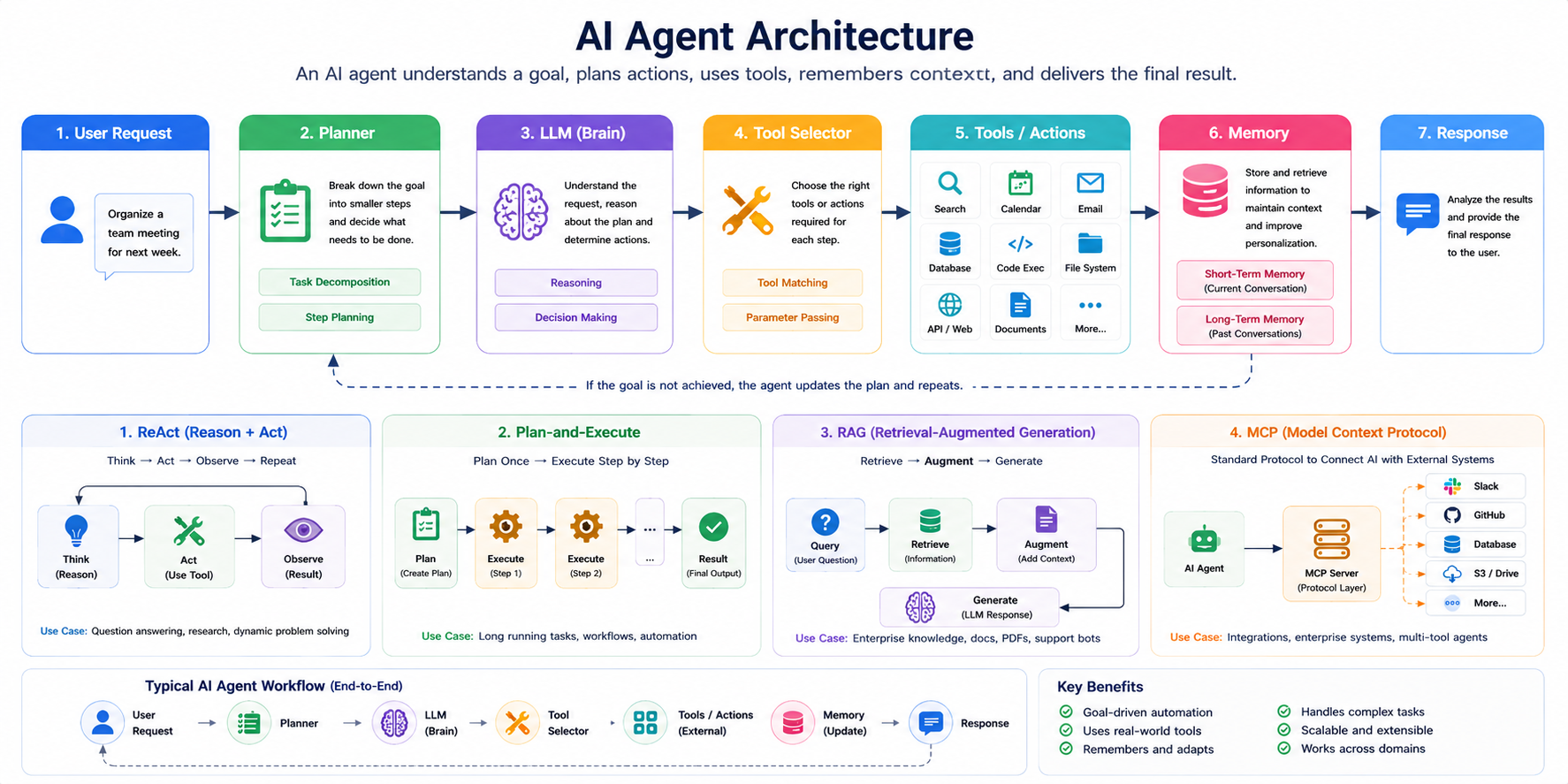
An AI agent may look very intelligent, but it is built using a few core components that work together. Each component has a specific role.
1. Large Language Model (LLM)
The Large Language Model (LLM) is the brain of the AI agent. It understands user requests, analyzes the problem, and generates responses.
Some popular LLMs are:
GPT
Claude
Gemini
Llama
However, an LLM has limitations. It cannot access real-time information or perform actions on its own. It needs other components like tools and memory to become a complete AI agent.
2. Memory
Memory helps the AI agent remember information and maintain context during conversations.
AI agents generally use two types of memory:
Short-Term Memory – Stores information for the current conversation.
Long-Term Memory – Stores important information for future conversations.
Memory makes the agent more personalized and avoids asking the same questions repeatedly.
3. Tools
Tools allow an AI agent to interact with external systems and perform real-world tasks.
Some commonly used tools include:
Search Engine
Database
Weather API
Email Service
Calendar
Code Execution
File System
4. Planning
Planning helps an AI agent solve complex tasks by breaking them into smaller steps. Instead of answering immediately, the agent first decides what needs to be done.
Example
User Request:
"Organize a team meeting."
AI Agent Plan:
Check everyone's calendar.
Find a common available time.
Create the meeting.
Send calendar invitations.
Notify all participants.
Planning helps the AI agent complete tasks in a structured and efficient way, especially when multiple actions are required.
How Does an AI Agent Work?
A typical AI agent follows a simple workflow.
Step 1: Understand the user's request.
Step 2: Decide whether external tools are required.
Step 3: Create a plan.
Step 4: Execute each step.
Step 5: Analyze the results.
Step 6: Continue until the goal is completed.
This continuous cycle allows the agent to adapt whenever new information becomes available.
Popular AI Agent Architectures
Different tasks require different types of agent architectures.
ReAct Agent
One of the most popular approaches is the ReAct (Reason + Act) architecture.
Instead of answering immediately, the agent repeatedly follows three simple steps:
Think → Act → Observe
For example:
A user asks:
"Find the best laptop under ₹80,000."
The agent:
Thinks about what information is needed.
Searches online stores.
Observes the search results.
Compares specifications.
Repeats the process if necessary.
Produces the final recommendation.
This iterative process allows the agent to adapt when new information is discovered during execution.
Plan-and-Execute Agent
Another common architecture separates planning from execution.
First, the agent creates a complete plan.
Then it executes each step one by one.
This approach is useful for structured tasks such as report generation, software deployment, or workflow automation because it reduces unnecessary reasoning during execution.
Retrieval-Augmented Generation (RAG)
One challenge with Large Language Models is that they may generate outdated or incorrect information, a problem commonly called hallucination.
Retrieval-Augmented Generation (RAG) solves this problem.
Instead of relying only on the model's internal knowledge, the AI agent first retrieves relevant information from trusted sources such as company documents, PDFs, databases, or knowledge bases.
It then uses this information to generate an accurate response.
For example, a hospital AI assistant can answer questions using the hospital's latest medical guidelines instead of relying only on the model's training data.
This makes enterprise AI systems more reliable and easier to keep up to date without retraining the model.
Model Context Protocol (MCP)
Modern AI agents often need to connect with many external systems such as Slack, GitHub, databases, APIs, cloud storage, and business applications.
Traditionally, developers had to build a separate integration for every AI application.
The Model Context Protocol (MCP) provides a common standard for connecting AI systems to external tools and data sources.
A simple way to understand MCP is to think of it as USB for AI applications. Just as USB allows many devices to use the same connection standard, MCP allows AI agents to communicate with different tools using a common protocol. This reduces development effort and makes integrations easier to maintain.
Real-World Applications
AI agents are already being used in many industries.
In healthcare, they help summarize patient records, assist with documentation, and support doctors by retrieving medical information.
In software development, code agents can generate code, run tests, identify bugs, and suggest improvements.
Customer support teams use AI agents to answer questions, process refunds, and track orders.
Financial institutions use them for fraud detection, report generation, and customer assistance.
Travel companies use AI agents to search flights, compare hotels, create travel plans, and estimate budgets.
These examples show that AI agents are becoming practical business tools rather than experimental technology.
Challenges
Although AI agents are powerful, they are not perfect.
Some common challenges include:
Incorrect reasoning leading to wrong decisions
Hallucinations when reliable data is unavailable
Higher operational costs due to multiple tool calls
Security risks when accessing external systems
Privacy concerns while handling sensitive information
Longer execution time for complex workflows
Building production-ready AI agents requires careful monitoring, validation, and proper security controls.
The Future of AI Agents
AI agents are expected to become an essential part of everyday work.
Instead of replacing people, they will act as intelligent assistants that automate repetitive tasks, retrieve information, coordinate workflows, and support better decision-making.
Future agents will work together as multi-agent systems, where specialized agents collaborate to solve large problems. They will integrate more deeply with enterprise applications, business workflows, and cloud platforms, enabling organizations to automate increasingly complex processes.
Conclusion
AI agents represent the next major step in the evolution of Artificial Intelligence. Unlike traditional chatbots, they combine language understanding, reasoning, planning, memory, and tool usage to complete real-world tasks. Technologies such as ReAct, Plan-and-Execute, RAG, and MCP are making these systems more capable, reliable, and useful across industries.
As AI continues to evolve, understanding how AI agents work will become an important skill for software developers, solution architects, business analysts, and technology leaders. Organizations that learn to design and deploy intelligent agents today will be better prepared for the future of AI-driven automation.
The journey from simple chatbots to autonomous AI agents has only just begun, and it is likely to transform the way people build software, solve problems, and interact with technology in the years ahead.
Promote this post
Share & amplify
LinkedIn post generator
Generate a polished, professional LinkedIn post from this article. Edit before posting.
Comments (0)